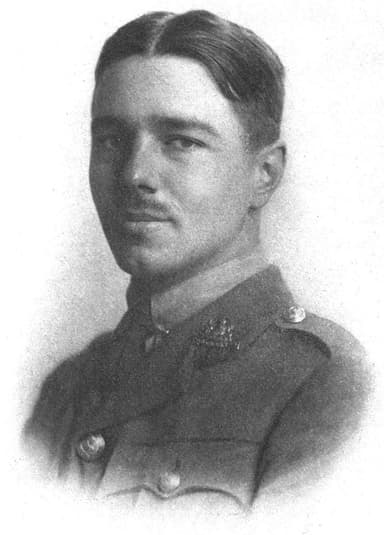
Siegfried Loraine Sassoon was born in 1886 into a wealthy Anglo-Jewish family in Kent, England. He grew up hunting foxes, playing cricket, and writing romantic verse—a comfortable Edwardian life that the First World War would shatter.
When war broke out in 1914, Sassoon enlisted and went to the Western Front, where his reckless bravery earned him the Military Cross. His fellow soldiers nicknamed him "Mad Jack" for his daring solo trench raids, which could lead to death or decoration, sometimes both. However, the horrors he witnessed in the trenches—the mud, the gas, the senseless loss of young lives—transformed him from a patriotic volunteer into one of the war's most vocal critics.
“His early war poems still reflect some romantic idealism, but by 1916, the tone had shifted to something harsher and more dangerous: bitter satire aimed not at the enemy but at the generals, politicians, and civilians back home who supported the war from a safe distance. Poems like *The General* and *Base Details* critique military incompetence with a precision that feels less like poetry and more like a controlled explosion.”
In July 1917, Sassoon took an almost unprecedented step for a decorated officer: he issued a public statement refusing to return to the front. He described the war as a deliberate extension of suffering by those who had the power to stop it. The army, unwilling to court-martial a war hero, instead sent him to Craiglockhart War Hospital in Edinburgh, officially to treat his "shell shock."
At Craiglockhart, he met Wilfred Owen, then an obscure poet trying to find his voice. The two developed a close friendship, and Sassoon's impact on Owen was significant—there's a clear line from Sassoon's stark realism to the poems that brought Owen fame. Sassoon eventually returned to the front and was wounded in 1918.