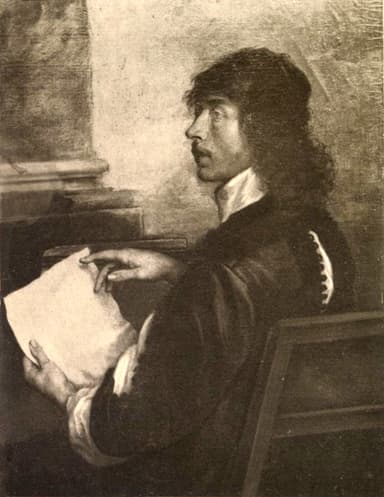
Abraham Cowley was born in London in 1618, the posthumous son of a stationer, and he displayed his talents early on—his first collection of poems was published when he was just fifteen. This early achievement set the stage for a life devoted to literature and ideas.
He attended Trinity College, Cambridge, where he became deeply engaged with the intellectual movements of his time. When the English Civil War erupted, Cowley sided with the Royalists. He followed the court into exile in France, where he worked as a cipher secretary for Queen Henrietta Maria, encoding and decoding diplomatic correspondence for several years. This unglamorous and tedious role didn’t match his abilities, and those long years abroad cost him the stable literary career he might have otherwise pursued.
“After Charles II was restored to the throne in 1660, Cowley returned to England, hoping for recognition and reward from the Crown.”
However, he received far less than he believed he deserved. He spent his later years in relative seclusion in the English countryside, writing essays and tending to a garden—activities he truly enjoyed, even if they marked a retreat from his earlier ambitions.
He passed away in 1667, and in the years following his death, his reputation soared. Between 1668 and 1721, his collected works went through fourteen printings, a remarkable feat that highlights how seriously his contemporaries regarded him. He was considered one of the great voices of the century, alongside Donne and Jonson.