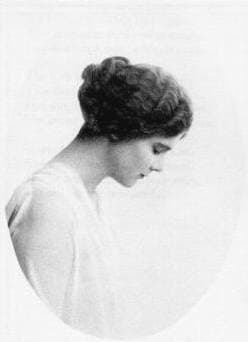
Sara Teasdale was born in 1884 in St. Louis, Missouri, as the youngest child in a comfortable, religious family. Growing up, she was often sick and received much of her education at home before attending a private girls' school. This early focus on her inner life shaped the introspective and finely tuned voice that would come to define her poetry. By her early twenties, she began publishing poems, and her reputation steadily grew throughout the 1910s, making her one of the most widely read lyric poets in America.
In 1914, she married Ernst Filsinger, a businessman from St. Louis, but the marriage was an uneasy match. While Filsinger deeply admired her, Teasdale felt suffocated by the domestic life. She had previously been in love with the poet Vachel Lindsay, and that tension between desire and constraint permeates much of her best work. She divorced Filsinger in 1929.
“Her 1917 collection, *Love Songs*, won her the Columbia University Poetry Society Prize, which was later recognized as the first Pulitzer Prize awarded for poetry.”
This recognition was well earned; the poems in that collection are spare, musical, and emotionally direct, which was quite unusual for the time. Teasdale wasn't interested in obscurity or experimentation for its own sake; she aimed for her poems to resonate clearly, like a stone falling into still water.
As she grew older, her writing became quieter and more focused on themes of death and solitude. She moved to New York City, where her later years were marked by increasing isolation, poor health, and depression. She died in January 1933 at the age of forty-eight from an overdose of sleeping pills—her death was ruled accidental but is often viewed as a suicide.