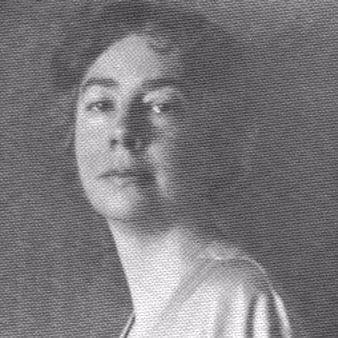
Elinor Morton Wylie was born in 1885 in Somerville, New Jersey, into a well-connected family with deep roots in American political life — her father served as Solicitor General under Theodore Roosevelt. That privileged upbringing gave her access to education and culture, but her personal life was anything but smooth. She caused a genuine scandal when she abandoned her first husband and young son to run off with a married man, Horace Wylie, in 1910. The couple fled to England to escape the social fallout, living there until the outbreak of World War One forced them back to the United States.
She eventually married Wylie, then later the poet William Rose Benét, but it was her own writing that defined her final years. She arrived on the New York literary scene in the early 1920s and became one of its brightest fixtures almost immediately. Her first major collection, *Nets to Catch the Wind* (1921), announced a poet with a sharp, jewel-like precision — someone who cared deeply about craft and formal control. Collections like *Black Armour* (1923) and *Trivial Breath* (1928) confirmed that reputation.
“Wylie was celebrated as much for her striking physical presence as for her verse, which was a double-edged thing: it meant she was the center of every room she walked into, but it also meant critics sometimes struggled to see past the persona to the work itself. The work deserves better than that. Her poems are dense with sensory detail, formally tight, and emotionally restless — she had a gift for making beauty feel slightly dangerous, as if it might cut you if you held it wrong.”
She also wrote four novels, including *Jennifer Lorn* (1923) and *The Venetian Glass Nephew* (1925), which found an audience at the time but are less read today. Poetry remained her real territory.
Wylie died suddenly in December 1928, just a few hours after completing the manuscript for her final collection, *Angels and Earthly Creatures*. She was forty-three. The collection was published posthumously in 1929 and is considered by many readers to be her finest work — a sequence of sonnets that channels longing and loss with a directness her earlier books sometimes kept at arm's length. She left behind a body of work that rewards anyone willing to slow down and read it carefully.