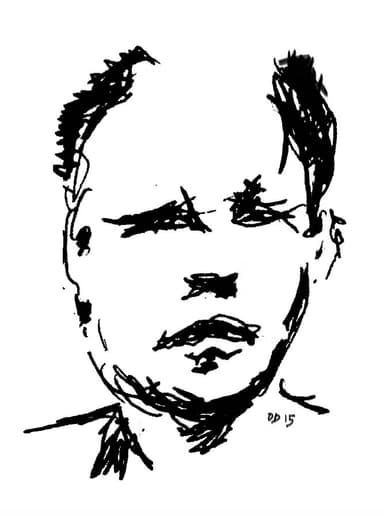
Charles Bukowski was born Heinrich Karl Bukowski in Andernach, Germany, in 1920, and moved to Los Angeles with his family as a child. That city had a lasting grip on him, and he held on just as tightly. The sprawl, the dive bars, the post offices, the horse tracks — all of these elements became the raw material for one of the most unique voices in American poetry.
His early life was tough in ways that leave lasting impressions. His father was abusive, and Bukowski grew up in poverty during the Depression, suffering from severe acne as a teenager that left him scarred and socially isolated. He began drinking young and started writing even younger, submitting work to literary magazines throughout his twenties and accumulating rejection slips by the hundreds. After nearly a decade of quitting writing, he worked a series of dead-end jobs and drank heavily enough to land in the hospital with a life-threatening bleeding ulcer in his early thirties. Upon leaving the hospital, he returned to writing, with renewed vigor.
“For eleven years, he worked as a mail sorter for the U.S.”
Postal Service — a job he despised and continuously mined for material. His first poetry collection was published when he was already in his mid-forties. In 1969, small press publisher John Martin offered him a monthly stipend to leave the post office and write full-time. Bukowski accepted the offer, and the novel that resulted, *Post Office*, kicked off the second and more prolific phase of his career.
He produced thousands of poems, dozens of short stories, and six novels. His style is instantly recognizable: short lines, straightforward language, no frills, a narrator who is often broke, drunk, or both, yet somehow still humorous. Critics who dismissed him as a lowbrow alcoholic overlooked the craftsmanship beneath the confessional exterior — the timing, the compression, and the way a Bukowski poem can shift from bleakness to tenderness in a single line.