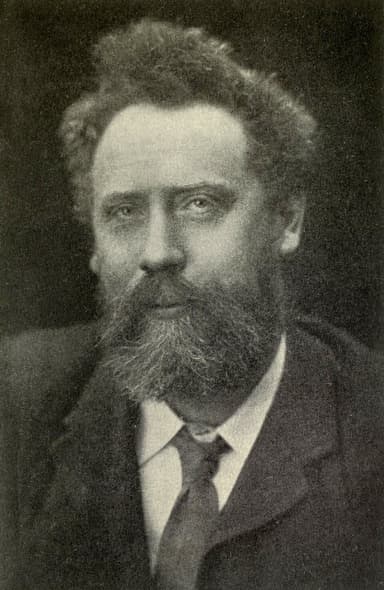
William Ernest Henley was born in Gloucester, England, in 1849, into a family that faced hardships from the start. As a child, he contracted tuberculosis of the bone, which resulted in the amputation of his left leg below the knee during his early teens. The disease also threatened his other leg, and in his twenties, he spent nearly two years in the Edinburgh Infirmary under the care of the pioneering surgeon Joseph Lister. It was during that long hospital stay that he wrote a series of poems later published as *In Hospital* — candid, unsentimental reflections on pain, boredom, and the strange intimacy found in the ward. Those poems alone would establish him as a figure doing something genuinely innovative in Victorian verse.
He survived, moved to London, and immersed himself in the city's literary scene with an energy that feels almost defiant given his physical struggles. He edited several influential journals, most notably the *Magazine of Art* and later the *Scots Observer* (which became the *National Observer*), using those platforms to support writers he admired — Robert Louis Stevenson, Rudyard Kipling, H. G. Wells, and Thomas Hardy all came into his realm. His friendship with Stevenson became one of the great literary partnerships of the era, though it ultimately ended in a bitter fallout over a memoir Henley believed misrepresented their shared history.
“Stevenson, in turn, drew on Henley's physical presence and strong personality when creating Long John Silver in *Treasure Island* — the peg-legged pirate who commands attention despite his disability.”
It's a complex form of tribute, and Henley reportedly had mixed feelings about it.
His daughter Margaret, born in 1888, had a charming habit of calling J. M. Barrie — a family friend — her "fwendy-wendy," a toddler's mispronunciation of "friendly." She passed away at age five, and Barrie honored her by naming Wendy Darling in *Peter Pan*. Henley outlived his daughter by just a few years, passing away in 1903 at the age of fifty-three.