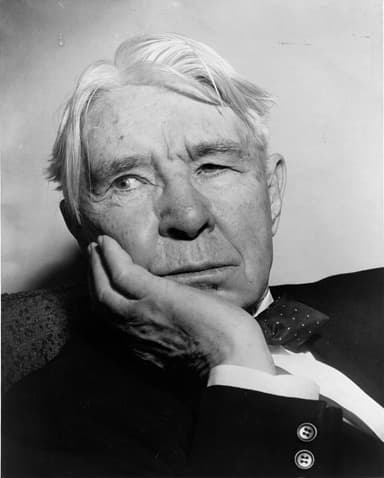
James Dickey was born in 1923 in Atlanta, Georgia, and spent his childhood in the suburb of Buckhead. The area's woods, rivers, and red clay landscapes left a lasting impression on his writing. He flew combat missions as a fighter pilot during both World War II and the Korean War, experiences that infused a physical intensity into nearly all of his work. After the wars, he found himself in advertising in Atlanta and New York, crafting poems on the side before ultimately leaving a promising career to focus entirely on literature.
His big break came in the early 1960s with a series of poetry collections that established him as one of the most vibrant voices in American poetry. He won the National Book Award for Poetry for *Buckdancer's Choice* in 1966, the same year he became the 18th United States Poet Laureate. In this role, he actively brought poetry into the public sphere, displaying genuine enthusiasm instead of keeping it at a distance. He also earned a Guggenheim Fellowship, and his critical writings influenced how a generation viewed the potential of poetry.
“In 1970, he published *Deliverance*, a novel about four Atlanta businessmen whose canoe trip through a remote Georgia river takes a violent turn.”
The book became a huge bestseller and was adapted into a celebrated film in 1972, making Dickey's name known to millions who might not have read his poetry. He wrote the screenplay and even had a role as a sheriff in the film. However, the novel's success had mixed consequences — it brought him fame but also led some critics to view him more as a popular entertainer than the serious poet he truly was.
In his later years, Dickey taught at the University of South Carolina, where he was known for being a demanding and theatrical figure in the classroom. His personal life was tumultuous; he drank heavily and embraced a macho persona that sometimes eclipsed his work. Yet, his poems stand apart: they are expansive, rhythmically unique, filled with animals, darkness, and a profound tenderness for the living world.