Skip to content
Storgy

The Poet Index · Entry 437

Sophocles
Poems

Lifespan
-496–-406
Nationality
Classical Athens
Indexed Works
0

Sophocles was born around 496 BCE in Colonus, a village near Athens, and lived nearly to ninety — long enough to see his beloved city reach its zenith and then begin to unravel during the Peloponnesian War.

Editorial intro

Storgy editorial

Editorial intro

Sophocles achieved what no other Greek playwright could: he made fate feel personal. While his rivals focused on divine machinery or raw psychological exposure, Sophocles placed fully human characters at the center — individuals who make real choices, understand the stakes, and still walk straight into catastrophe. This tension keeps Oedipus Rex and Antigone alive over 2,400 years after their initial performances in Athens.

He also transformed theater by adding a third speaking actor to the stage, allowing genuine conflict between characters instead of relying solely on the chorus. Audiences of his time took notice — he entered about 30 competitions and won 24, never finishing below second place. Modern readers often find two aspects surprising: the rapid pace of the plays and the limited role of the gods in providing explanations. Sophocles does not seek to offer cosmic comfort. His characters are trapped by forces beyond their control, yet they are held accountable for their decisions. This refusal to provide easy exits is why writers from Aristotle to Seamus Heaney repeatedly engaged with his work, and why you should as well.

Recurring themes

Biographical record

About Sophocles

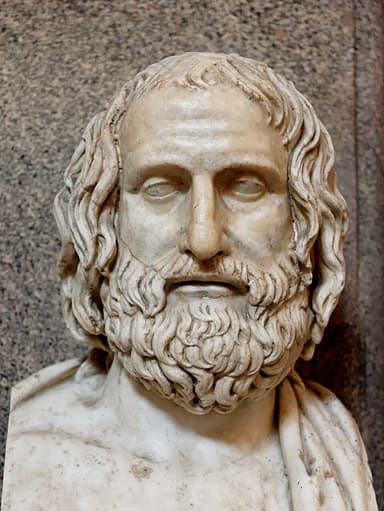
Sophocles was born around 496 BCE in Colonus, a village near Athens, and lived nearly to ninety — long enough to see his beloved city reach its zenith and then begin to unravel during the Peloponnesian War. Coming from a wealthy family, he received a solid education in music and gymnastics, and he was the kind of person that fellow Athenians genuinely liked: charming, civic-minded, and curious about the world.

Over his career, he wrote more than 120 plays, but only seven survive in full, which is a stark reminder of how much has been lost to time. Those seven — Ajax, Antigone, Women of Trachis, Oedipus Rex, Electra, Philoctetes, and Oedipus at Colonus — are enough to ensure his legacy for thousands of years, so the overall outcome still seems favorable for him.

What distinguished Sophocles from his peers was his grasp of character.

While Aeschylus built grand theological narratives and Euripides leaned into psychological realism, Sophocles found a balance: characters who are fully human yet ensnared by forces beyond their control. His characters make choices, and those choices often cost them dearly. This tension — between human agency and fate, between awareness and denial — fuels nearly every play he crafted.

He competed in Athens' dramatic festivals for decades, participating in contests at the Dionysia and the Lenaea, where playwrights showcased their work to thousands as part of a religious celebration. He entered about 30 competitions, won 24 of them, and never placed lower than second. Aeschylus, his great predecessor, won 13 times, while Euripides, his younger contemporary, won four. These figures aren’t just trivia — they indicate that Sophocles was not only respected by scholars and later generations but genuinely loved by the audiences of his time.

Biographical span
-496Birth
-406Death

Poets in the same orbit

Reader questions

Frequently asked

Why does Sophocles matter if he wrote plays, not poems?

The line between poetry and drama was nonexistent in ancient Athens. Sophocles wrote his works in verse, using iambic trimeter for dialogue and intricate lyric meters for choral odes, with the plays being part of a rich poetic tradition. Engaging with his texts is like engaging with poetry. The theatrical setting simply means that the poetry features characters who are debating and interacting within it.

What is Sophocles' most famous work?

Oedipus Rex has been the quintessential example of Greek tragedy for more than two thousand years, largely due to Aristotle's reference to it in his Poetics. The tale of a man who unravels a mystery only to find he is the culprit still captivates audiences today. Additionally, it inspired Freud's concept of the Oedipus complex, although Sophocles might consider that interpretation overly simplistic.

What is the difference between Sophocles, Aeschylus, and Euripides?

Aeschylus is the oldest and the grandest—his plays resonate like religious rituals, grappling with cosmic justice and divine will. Euripides feels the most modern, delving into psychology, exploring women's inner lives, and challenging heroic myths. Sophocles occupies the space between them: his characters are fully realized humans, yet they navigate a world where fate and the gods exert real influence, and it's this clash between human stubbornness and a greater order that fuels his drama.

Do I need to know Greek mythology to read Sophocles?

A little background is helpful, but not as much as you might expect. Sophocles' original audiences were already familiar with the myths, allowing him to concentrate on his characters' reactions to their circumstances instead of relying on plot twists. A brief summary of the relevant myth before you start reading will suffice. The emotional depth of the plays will guide you from there.

Which translation of Sophocles should I read?

For Oedipus Rex, Robert Fagles' translation is tough to top—it’s quick-paced and impactful. David Grene's translations in the University of Chicago series take a more literal approach, making them great for deep study of the text. When it comes to Antigone, Anne Carson's version is minimal and unusual, adding a fresh sense of danger to the play.

What are the main themes running through Sophocles' plays?

Fate versus free will is a central theme — his characters often face choices, yet they tend to choose paths that lead to their downfall, prompting us to question how free those choices truly are. Alongside this, he explores the limits of human understanding, the dangers of pride, the conflict between loyalty to family and loyalty to the state, and the meaning of a good death. These aren't just theoretical dilemmas for him; they're real struggles that people endure.

What happened to the other 113-plus plays Sophocles wrote?

They were lost mainly due to the gradual decline of the institutions that copied and stored manuscripts during late antiquity and the early medieval period. We have fragments—sometimes only a few lines, sometimes a larger section—but nothing intact. The survival of the seven we possess is due in part to luck and in part to their use as school texts in Byzantine education, which ensured they were continually copied.

Is Antigone really about civil disobedience?

It touches on several themes. Antigone goes against the king's order to bury her brother, believing that divine law is more important than human law. This clash — personal conscience versus state power — is why the play remains relevant during political turmoil. It also explores grief, the stubbornness of both parties, and how two people can each hold valid views while still causing destruction.