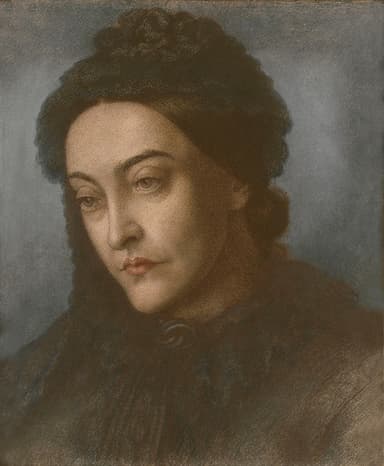
Paul Verlaine
1844–1896
France
About Paul Verlaine
Paul Marie Verlaine was born in Metz, France, in 1844 and became one of the most unique voices in nineteenth-century French poetry. He studied in Paris, quickly immersing himself in literary circles and publishing his first collection, *Poèmes saturniens*, in 1866 at just twenty-two.…
Similar poets
FAQ
He's primarily associated with Symbolism, but he also has connections to the Parnassian school and is frequently grouped with the Decadent poets. However, he doesn't fit neatly into any single category. His writing is too musical and emotionally resonant for the detached formalism of the Parnassians, and too personal and lyrical for the more structured Symbolists. It's best to see him as a figure who contributed to the environment from which those movements emerged.
It was one of the most notorious and tumultuous relationships in literary history. Verlaine was married when the young Rimbaud showed up in Paris in 1871, carrying a letter and a collection of remarkable poems. The two quickly became lovers, leaving their old lives behind to travel through Belgium and England. Their relationship was rocky from the beginning. It came to a head in 1873 when a drunken and desperate Verlaine shot Rimbaud in the wrist during a heated argument in Brussels. Verlaine ended up in prison, while Rimbaud ultimately walked away from poetry. Yet, despite the chaos, their time together sparked a creative fire for both of them.
It's a poem Verlaine wrote in 1874 that serves as a manifesto for his vision of poetry. He emphasizes that music should come first — prioritizing sound, rhythm, and emotion over argument, description, or moral lessons. He advocates for nuance instead of blunt statements and cautions against the overly ornate style that was popular at the time. This work became highly influential, laying the groundwork for Symbolist poetry in France and beyond.
Yes, definitely. His time in prison led to the creation of *Sagesse* (1881), a collection marked by deep devotion and real spiritual conflict. The poems in this collection are more straightforward and less whimsical than his previous pieces — he’s grappling with themes of guilt, grace, and the hope for redemption instead of simply seeking out pleasure. Some readers favor the earlier Verlaine, while others see *Sagesse* as his most authentic emotional expression. Both opinions are valid.
Because he put the sound of a line above nearly everything else. He liked unconventional syllable counts that gave his work a lopsided, lilting rhythm, frequently employed assonance and internal rhyme, and crafted poems so that the emotional impact hit the ear before the brain could grasp the meaning. Even if you don’t speak French fluently, reading him in that language allows you to feel what he’s doing. This is precisely why translators often struggle with his work.
Enormously, and in both directions. The Rimbaud affair scandal, along with his prison sentence, struggles with alcoholism, and poverty, painted him as a disreputable figure in respectable circles for much of his life. Yet, these same experiences also transformed him into a romantic symbol for younger writers who admired the idea of the poet as an outcast. By the time he died, he had been voted 'Prince of Poets' by French literary figures — a title that reflected both his mythical status and the impact of his poetry.
In French, no — his poems are generally short, straightforward, and deeply impactful. The challenge lies in the fact that much of his work relies on sound, so translations can differ significantly in how well they convey his essence. If you're reading in English, it's a good idea to experiment with different translators to find one that presents his work as poetry, not just a prose summary.
The list is extensive. In France, he directly influenced the Symbolists that came after him, notably those in Stéphane Mallarmé's circle. Across the English-speaking world, poets such as Ernest Dowson and Arthur Symons embraced his style, allowing his ideas to seep into early modernism. T.S. Eliot references him in *The Waste Land*. His focus on music and suggestion rather than straightforward declarations significantly impacted how many poets in the twentieth century viewed the purpose of poetry.