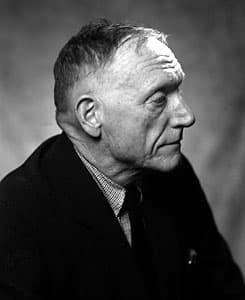
Robinson Jeffers was born in Pittsburgh, Pennsylvania, in 1887, to a Presbyterian minister and classical scholar who ensured his son was reading Greek by the age of five. During Jeffers's childhood, the family traveled extensively through Europe, allowing him to pick up several languages before entering formal schooling. He graduated from Occidental College at eighteen and then moved between graduate programs in literature, medicine, and forestry. This restlessness never quite settled into a traditional career, and perhaps it was for the best.
In 1914, everything changed when Jeffers and his wife Una relocated to Carmel, California. That stretch of the Big Sur coastline—complete with granite headlands, sea stacks, and the relentless Pacific—became the focal point of his creative life. He spent years constructing Tor House by hand from local stone and later added a stone tower for Una. Rather than being a retreat from the world, it served as a vantage point for observing it clearly.
“While his early collections garnered some attention, it was *Tamar and Other Poems* (1924) and *Roan Stallion* (1925) that solidified his reputation.”
These works featured long, violent, myth-infused narratives set against the California coast, striking readers as something genuinely new. Throughout the late 1920s and 1930s, Jeffers became a prominent literary figure, even appearing on the cover of *Time* magazine, with his adaptations of Greek tragedy performed on Broadway.
However, everything changed with the Second World War, leading to a rapid decline in Jeffers's reputation. His 1948 collection *The Double Axe* contained poems that opposed American involvement in the war and expressed a stark disdain for nationalism on all fronts. In an unusual move, his publisher, Random House, printed a disclaimer to distance themselves from his views. Critics turned against him, and the reading public largely followed suit.