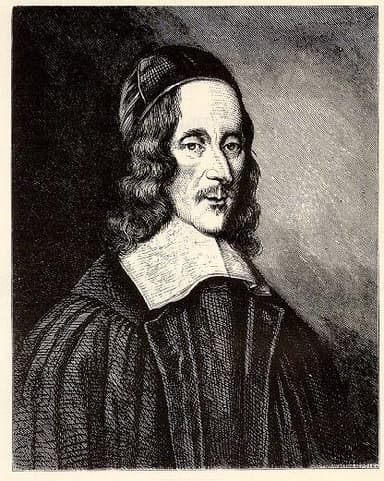
John Donne
1572–1631
Kingdom of England
About John Donne
John Donne was born in London in 1572 to a Catholic family at a time when practicing that faith in England posed significant legal dangers. His mother was related to the martyr Thomas More, and that legacy of quiet resistance permeates his entire life story.…
Similar poets
FAQ
It's a label that critic Samuel Johnson used in the 18th century for Donne and a group of poets who followed him. He suggested they were too intellectual, pushing unusual comparisons—what he referred to as 'conceits'—into their poems. A well-known example is Donne likening the souls of two lovers to the two legs of a compass. Johnson saw this as pretentious, while most readers today find it brilliant. The term has persisted as a category name, despite its origins as a critique.
The honest answer is likely both reasons at once. In late 16th century England, practicing Catholicism was both dangerous and professionally limiting. Donne couldn't earn a university degree, hold public office, or escape social exclusion. However, his remaining writings reveal a genuine struggle with theology — he engaged deeply with both Protestant and Catholic doctrines and didn't take the issue lightly. His conversion was gradual, not abrupt, and his religious poetry reflects someone who continued to wrestle with God rather than someone who had comfortably settled all their questions.
Her father, Sir George More, was furious. He had Donne thrown in jail for a short time and got him fired from his position as secretary to Sir Thomas Egerton. It’s said that Donne wrote to Anne from prison: 'John Donne, Anne Donne, Un-done.' Whether he actually penned that or it’s just a later fabrication, it really reflects their predicament. The couple struggled with financial issues for years, depending on the kindness of patrons, until Donne's career in the church finally brought them some stability.
Some of it is, yes — he assumes that readers are familiar with classical mythology, theology, and contemporary science. However, the challenge is rarely about obscurity for its own sake. He typically presents a specific argument, and once you grasp the logic, the poems reveal themselves quickly. The love poems, in particular, have a straightforwardness beneath all the clever techniques. Beginning with poems like 'The Sun Rising' or 'Death, be not proud' offers you the argumentative style without needing extensive background knowledge.
Most Elizabethan love poetry stuck to the Petrarchan tradition — where the beloved is idealized, distant, and almost saintly, leaving the poet to suffer beautifully from afar. Donne rejected that approach. His lovers are right there, in the same room and in the same bed. He views physical desire as a topic worth serious contemplation rather than something to be softened with polite metaphor. He also portrays the woman in the poem as having her own thoughts and feelings, which was quite rare for the time. The tone can shift between playful, argumentative, tender, or cynical — sometimes all within the same poem.
A sequence of nineteen sonnets composed in the early 17th century, likely written after the death of his wife, Anne, in 1617. These poems are directed straight at God and hold nothing back — Donne pleads, accuses, despairs, and demands. The most well-known starts with 'Death, be not proud,' where he contends that death doesn't truly hold power over the soul. Another begins with 'Batter my heart, three-person'd God,' in which he asks to be spiritually shattered and rebuilt. They feel less like acts of devotion and more like heartfelt arguments with a figure Donne desperately needed to trust.
Tastes changed in the late 17th and 18th centuries, favoring clarity, polish, and emotional restraint — qualities valued by poets like Dryden and Pope. By these standards, Donne's complex syntax and emotional depth seemed outdated and excessive. However, a revival of interest began in the early 20th century, largely thanks to T.S. Eliot. He argued that Donne embodied a unified sensibility — the capacity to think and feel simultaneously — which later English poetry had neglected. Eliot's advocacy positioned Donne as a key figure in shaping how modernist poets viewed their own work.
It's the sermon Donne delivered at Whitehall in February 1631, just weeks before his death. He appeared visibly ill, and members of the congregation reportedly remarked that he looked like a corpse. The sermon reflects on death as something intertwined with life from the start — birth itself can be seen as a form of dying. Donne also had a portrait made of himself wrapped in a burial shroud, standing on an urn, which he kept by his bedside during his last days. The pairing of the sermon and that portrait stands out as one of the more unusual and fascinating acts of self-presentation in English literary history.